
Galaxy Europe for Virology
Accessible and scalable viral data analysis for everyone
What’s this?
The Virology Galaxy workbench is a comprehensive set of analysis tools and consolidated workflows. The workbench is based on the Galaxy framework, which guarantees simple access, easy extension, flexible adaption to personal and security needs, and sophisticated analyses independent of command-line knowledge.
Full analysis solutions by viral pathogen
The Galaxy Project virology community has prepared full analysis solutions to support genome sequencing questions around several important human and animal viral pathogens. These solutions come as bundles of analysis workflows, data resources and accompanying training material that will allow researchers to get state-of-the-art and scalable sequencing data analysis for their virus of interest running in the shortest possible amount of time with zero installation effort.
Vetlab support

Galaxy Europe is offering ready to use workflows for veterinary laboratories under the IAEA Coordinated Research Project D32036: “Application of Advanced Molecular Characterization Technologies Through the Veterinary Diagnostic Laboratory Network (VETLAB Network)”.

If you are a VETLAB network member, you can jump directly to your workflow of interest.
Primer and primer scheme design

Need to design primers for a simple diagnostic PCR, primers and probe for qPCR, or an entire primer scheme for tiled-amplicon sequencing? We are offering access to varVAMP to cover your primer design needs.
A dedicated tutorial about varVAMP and using it together with MAFF-T is coming soon. In the meantime please refer to the excellent documentation of the tool. You can safely skip the installation instructions because we have taken care of that for you :-)
Tools, tools, tools
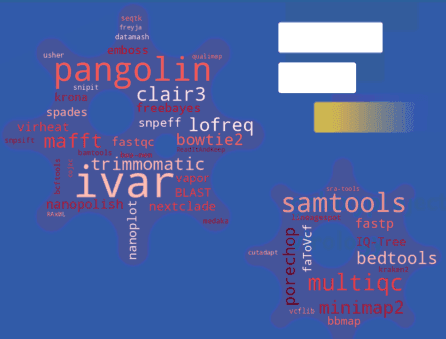
Whether you want to do quality control of your sequencing data, map reads to a reference genome, perform de-novo assembly of sequenced reads or lineage-assignment of your viral isolate, we strive to have the best tools available for you through convenient, but full-featured graphical user interfaces, and we offer enough computational resources for these tools to run properly.
Explore the tool panel on the left hand side to learn what’s there.
… and reference data
We also provide reference data for different viral pathogens to help you get your analyses running faster. These include collections of reference sequences, published primer schemes, different versions of pangolin-data for SARS-CoV-2 lineage assignment, etc., which are listed on the pathogen-specific pages above (see Full analysis solutions).
Something missing or not working?
To discuss what others think about the scientific value of including specific new tools, reference data or workflows join the Galaxy Project's Public-Health [m] matrix room, or mailing list
To report server-related issues join the Galaxy Europe Lobby on [m] matrix or submit a bug report directly from any failed dataset in your history.
Content
- Full analysis solutions by viral pathogen
- Vetlab support
- Primer and primer scheme design
- Tools, tools, tools
Our Data Policy
| Registered Users | Unregistered Users | FTP Data | GDPR Compliance |
|---|---|---|---|
| User data on UseGalaxy.eu (i.e. datasets, histories) will be available as long as they are not deleted by the user. Once marked as deleted the datasets will be permanently removed within 14 days. If the user "purges" the dataset in the Galaxy, it will be removed immediately, permanently. An extended quota can be requested for a limited time period in special cases. | Processed data will only be accessible during one browser session, using a cookie to identify your data. This cookie is not used for any other purposes (e.g. tracking or analytics). If UseGalaxy.eu service is not accessed for 90 days, those datasets will be permanently deleted. | Any user data uploaded to our FTP server should be imported into Galaxy as soon as possible. Data left in FTP folders for more than 3 months, will be deleted. | The Galaxy service complies with the EU General Data Protection Regulation (GDPR). You can read more about this on our Terms and Conditions. |